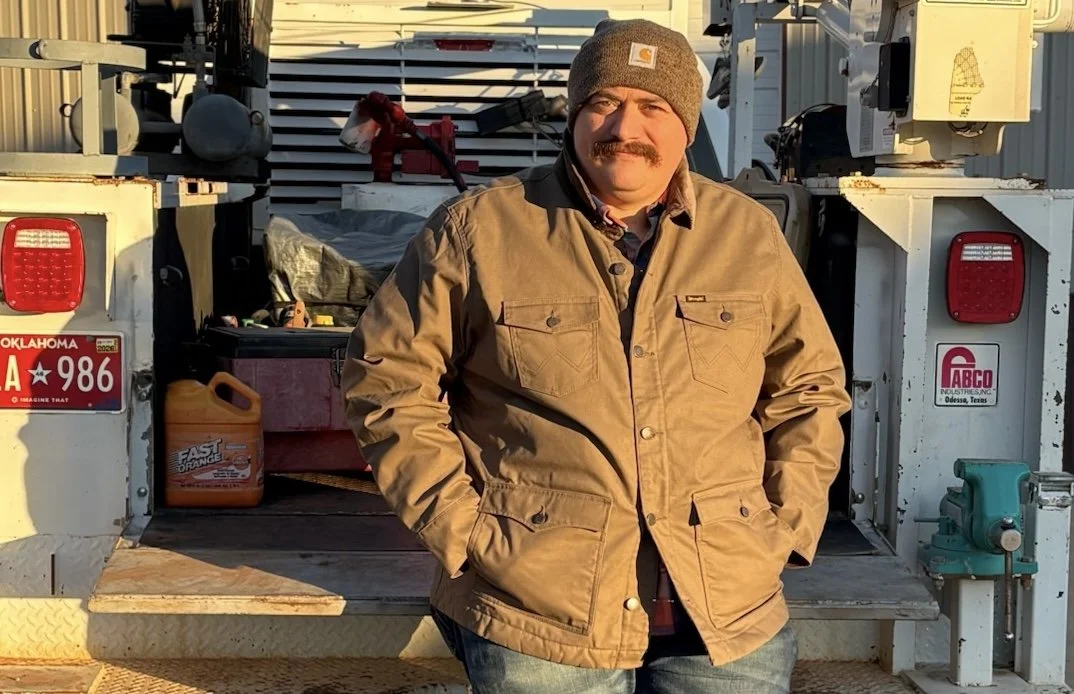
THE WATER TRUCK

Grandpa had a water well to drill, but his rig hand for the day was in the tank. He woke me up early and we loaded the casing and the gravel. He said he’d drive the drill and I’d follow in the water truck: a 1969 International tanker with a 10-speed road ranger transmission and no power steering.

I was eleven. I told him I didn’t know how to drive. I’d only ever driven our old Ford 8N tractor. He seemed surprised: “Why, hell son, it tells you how to drive right there on the stick.”

I hesitated. He placed his hand on my shoulder: “If you break something, I reckon we’re just gonna have to fix it. Won’t we?”

I nodded.

After a thirty-second lesson on the clutch, he hopped in the drill and took off. I followed him.


PEACOCKS

As a boy, I’d look up into the bare trees in West Texas and occasionally see peacocks, their plumage flashing against a landscape otherwise spare and dry. It was a shock of beauty in a place where survival itself felt unlikely.


HORSES

Uncle Bascom would tell me I had “a way with horses,” but once he passed away, they weren't present in my daily life the way cattle were. Grandpa hated horses after losing a kidney getting kicked by one as a boy.

The annual Beutler and Son Rodeo was the one time a year I didn't code-switch. I always wore western wear at home and whatever the hell I thought normal kids wore to school, but the rodeo was when I'd scrub and shine my Lucchese's, tuck in a denim pearl snap, brush and steam the brim on my weatherbeaten silverbelly Stetson, and pull out one of the belt buckles Uncle Bascom left me. While the local kids enjoyed their annual cowboy cosplay, I'd set up under the bleachers watching the horses coming and going.

It was wonderful.


GOLIAD

“Remember the Alamo! Remember Goliad!”

I hadn’t really remembered Goliad—at least not the way you’re supposed to. Four hundred young men—kids, really—lined up and shot for wanting Texas to be its own place and to finally have a stake in something. When I learned my great-great-grandpa Thomas Kemp was one of the twenty-eight who got away by making a sprint for the river while the guns were still firing, it was a hell of a feeling to realize I owe my entire life to the luck and tenacity of a 17-year-old in 1836.

It makes you wonder what else you don’t know.

Thomas only made it to age thirty-five. Hell, the poor guy probably survived all that just to step on a splinter and die from tetanus.


CONSTABLE

The abandoned Hollomon & Sons general store in Peacock, Texas has bullet holes in it.

Grandpa said that back during the Great Depression, a constable painted parking spots in front of the store and started handing out parking tickets.

One day somebody shot him right there in front of the general store.

Of the hundred or so locals of Peacock, no one saw anything.


RAIN

We hadn’t had a proper rain in a long time. Even as a child, I could tell the crops were struggling and that everyone in town was a little more irritable than normal. There were no fireworks again that year, and something as small as a cigarette flicked out a car window could burn tens of thousands of acres—livestock included.

I remember when the rain finally came—a real turd floater. Our whole class ran outside to see. Across the street, people poured out of storefronts to celebrate. The sweet smell of all that rain on all that dust.


NO TARDY SLIPS

My eighth-grade football coach loaded us onto a bus and drove us five miles out into the country. People had been skipping laps. He dropped us off, said he wasn’t signing any tardy slips, and drove back to the field house.

We ran the five miles back like he said. When we got there, we made sure to turn his car sideways in the parking lot, sandwiched between two others before we headed to sixth hour on time.


SUSHI

My sister ordered sushi at the mall on a high school field trip to Oklahoma City, two hours away.  It was so exotic It made the yearbook.


BROWN SUGAR FUDGE

2 cups brown sugar
Few grains salt
3/4 cup chopped walnut meats
3/4 cup cream
2 tablespoons butter
1 teaspoon vanilla

Dissolve sugar in cream, cook until soft ball stage when tested in cold water. Move from fire, add butter, nuts, and flavoring. Let cool. Beat until creamy. Press in buttered pan and cut in squares.


NEST

There was a large wasp nest hanging from the loft of our barn. I grabbed an armful of corn cobs and started throwing them. I turned to run as it fell. That’s when my cousin slammed the door shut laughing.


COVEY

It was early and cold. I was a teenager hunting with my cousins and uncles—an annual Thanksgiving tradition—when I came upon a covey of quail along a cattle rut. I hesitated as I raised my 12-gauge Remington. I knew it was "unsportsmanlike" to shoot quail when they were coveyed up.

Something spooked them, and the covey scattered with their characteristic flutter—their white tail feathers mocking my indecision as they darted off in all directions. I picked one and shot it. I felt naïve as I bagged the lone bird.

A few hours later one of my uncles Dick Cheneyed me in the shoulder. I was fine, but it hurt. I imagine there was more than vanilla Coke in that Sonic cup of his.


DALLAS

Once or twice a year we’d visit my aunt in Dallas. I’d spend hours playing on her stairs—I’d never been in a house with stairs before. She’d take us out to eat food we’d never seen before: Mediterranean at Café Izmir, Benihana where they’d cook right on the table.

The drive to Dallas was long, and we’d hit downtown at night. My sister and I had never lived fewer than a hundred miles from skyscrapers. We’d twist ourselves into the back window, craning our necks to see them — each one different, yet all equally foreign, monoliths of light rising out of the dark. I tried not to blink.


BLOWOUT

My dad and I were driving down the interstate when he said we were about to have a blowout. He eased off at the next exit, and we went into the Flying J for coffee and his go-to long-cut wintergreen Skoal. When we came back out, the tire had blown in the parking lot. We changed it and got back on the road.


MAX


Grandpa always made sure to visit Uncle Max when near Midland–Odessa. Max lost both his children when they were very young—one in a car, one to illness. He’d had a few wives. All he talked about was rough-necking—he was “hammer and tongs all day long.” If he wasn’t out drilling on a big rig in the Permian Basin, Grandpa knew you would always find him at the bar.


STOVE

The whole crew was waiting in line for the single-stall restroom in a wood-paneled hallway of a tiny gas station. The linoleum floor and the drop-tile ceiling were both stained that same brown-yellow you only seem to see in places like that. A cork board hung by the bathroom door, cluttered with Polaroids of people showing off their stringers of fish and a joke photo of a shanty someone had bolted onto the back of an old truck.

A coworker behind me pointed at it.
“Cody, they got a stove up in there.”

I grinned.
“I wonder what the poor people doin’?”


THE SALTY FROG

The opening of The Salty Frog snow cone stand announced the arrival of summer. It was a small blue hut with a faded painting of a frog in a tuxedo. The cherry salty frog was the local favorite: cherry, lime juice, and salt. My dad always ordered his with “extra cherry and extra frog.”


THE DRAG

The movie theater closed when I was seven. Toy Story was the last thing I saw there. I can still see the red velvet curtain, the teals, whites, and reds that ornamented the exterior, the marquee sign that’s probably still there.

The bowling alley went next, then the pool hall. By high school, all we had was “the drag”: a stretch of road downtown where kids just drove a loop over and over, headlights circling the same streets just to be seen.  There was nowhere else to go, so we went there.


LAND

We were setting up on our first hole for the day when it happened—the seasonal arrival of an armed farmer determined to have a bizarre territorial hissy fit.

“This is my… god…damn… land!” he barked, each word more unhinged than the last as he pointed his shotgun at me.

Like a hostage negotiator, I’d have to remind him that he’d signed permits for us to do this, and that—believe it or not—we’re looking for oil on his property.


KNIFE

I didn't know why the brawl started, but I did know why his hand went into his pocket. His light-wash cowboy-cut Wranglers had pockets so tight that grabbing his knife took longer than it should have. I kicked at his hand with the pitched heel of my 13D Lucchese’s in what felt like slow motion until he yanked it back out.


DAMN SHAME

At Simon’s Catch there’s not really a menu. The waitress just asks if you want steak or fish. I could hear two old farmers behind me.

“You hear about Virgil?”

“Yessir, shot himself in his truck. In that old Studebaker, no less.”

“That’s a nice truck.”

“He had it fixed up real nice. White-wall tires and everything.”

“What is that, a late… forties model?”

“I think it’s a 1950.”

“It’s a damn shame is what it is.”

“Yessir.”


IT’LL DO

I was checking into the “It’ll Do”—the only motel in Atwood, Kansas—for an 8-week job during summer break. I asked the owner for the wifi information.

“Sorry son, we ain’t got no internet.”


MILKY WAY

On moonless nights I’d throw on my lined coveralls, turn off our lone porch light, and drive out into the pasture. I’d climb into the bed of my truck and listen to the symphonies of Beethoven and Sibelius while I waited for my eyes to adjust and for the Milky Way to reveal itself. I had a red flashlight that I would use when switching CDs.

I’d try to imagine places away from all those shittin’ cattle that sounded like those symphonies.

I wondered what my world could sound like.


THE DORM

My first semester of college, I’d lie in bed awake at night. My back wasn’t sore. My neck wasn’t burned from the heat or my lungs from the cold. I’d watch the ceiling fan wobble.


CODY

I love my name. Cody always felt like the quintessential ‘80s white-trash name, in a good way. I like to joke that it’s short for “Codeine.”

When I was a boy, another Cody and I would walk to the United Supermarket to scour the parking lot for loose quarters. Once we’d scraped together enough, we’d celebrate the find the same way every time: two cold Dr. Peppers, bought with coins pulled from the hot asphalt.

If Smoky Joe—a local homeless guy—was lying on the fertilizer bags in his black leisure suit, we’d make sure to scrounge up enough for an orange Fanta. That was his favorite.


OUR DREAM

My dad was tired of waiting on other people to haul our equipment.  We went to a farm equipment auction to look for a semi. While he checked under the hood of a purple Kenworth that stood out among the others, I noticed the outline of a decal on the back of the cab. Looking closely, you could still read it: Our Dream.

There’s something haunting about stumbling across the remnants of other people’s abandoned aspirations, especially at farm auctions where people’s means of making an honest living get scattered to the wind. There’s a weight to that inherited hope—how one family’s abandoned dream becomes another’s foundation. We bought that truck that day. I’d like to think the previous owners moved on to greener pastures. But I know they probably didn’t.


THE KELLY

I used to help my dad and grandpa drill water wells on weekends and in the summer. For hours we’d stand in the heat, shoveling cuttings and staring at the Kelly driving the drill pipe deeper into the earth. I wanted to ask them about their childhoods, what my Granny Sue was like, what music their folks listened to. The rig in its mechanical complexity wouldn’t allow it. It was just too damn loud.


ORANGE

Grandpa said there would always be an orange in their Christmas stocking — a real treat, the only time they’d get citrus.

In the summer, I’d keep an orange soda in the ice chest for the end of the day — the colder the better.

The Fast Orange pumice soap in the truck bed would get hot from sitting in the sun, warm like shaving lather when you pumped it into your hands. I’d crack the ball valve on the water truck a half turn to let out the cold water, the smell of that soap cutting through the grease and mud as it washed me clean.

The taste and smell of oranges as we headed in from the workday.


SOUP


Grandpa wasn’t allowed to eat Campbell’s soup as a kid because of some old clan rivalry, and since I seem to have inherited the petty gene, I observe it too.
On cold days I’d set my off-brand can on the piping-hot engine block and leave it there until break time.


TEXAS CRUDE

I stood staring at a recently deceased cow, flies buzzing, the stench beginning to rise. I felt sad for the poor thing just lying there, exposed and rotting. Someone walked up next to me and broke the spell by calling out: “Now there’s me some pussy.”


SINGLE-WIDE

I remember the sound of our tires crunching onto the gravel pad outside my uncle’s single-wide trailer near Post, Texas. Looking through the bay window revealed nothing but crushed beer cans. His girlfriend stood in the doorway with a cigarette, jorts, jellies, and curlers. My uncle had a stale smell I couldn’t place.

Even as a young teenager, I could feel the inevitability of it all. He died before I ever saw him again.


FIRE ANTS

When I was eight, I got swarmed by fire ants while I was playing with army men in front of our trailer. I remember how much my tall boot socks itched. I went straight to the barn, grabbed a plastic gasoline can and a lighter, and doused their mound. I’d had enough of the ants, the snakes, spiders, and centipedes. I remember how fast the whole thing went up in flames. I watched them burn.


THE BASS

I went fishing with a few buddies at a pond just off Route 66. Someone said he had permission to fish there, but his occasional scanning for the game warden suggested he didn't. It was gonna be hard to feign ignorance being parked directly in front of the "NO FISHING" sign. The pond was surrounded by trees but I found a nice spot with just enough room to cast sideways.

Then I hooked it. The water in front of me billowed as I went to set the hook. It didn't take long before it jumped out of the water and spit my H&H double spinner out. It had to have been at least seven pounds. Nobody else saw it. I stood stunned as the ripples in the water leveled out.


TORNADOES

I was scared of tornadoes as a child. I helped my dad put old tires on the roof of our trailer to dampen the constant rumbling from the wind. Sometimes, we'd have to leave suddenly in the middle of intense storms to get somewhere safer, and we were a long way from town. I’d watch for funnels through the rain all the way to the fire station whenever the lightning briefly illuminated the countryside. I had nightmares for years that tornadoes were chasing our truck in the dark.


WALMART

On a break from graduate school at Hopkins, I took my wife to visit my hometown. It was the first time I’d been back since leaving the oilfield. We ran into an old high-school friend at Walmart,  in that awkward strip between the checkout registers and the iceboxes. He was skinny with the  hollow look of someone who’d been using. He told me he was still trying to save up enough to "get out.".

I was uncharacteristically quiet. I remember looking down at my Allen Edmonds Oxfords and not understanding how quickly I felt like I lived a world away.

My wife was very affected by it. I told her to get used to it.


PANHANDLE TO DC

At the National Aquarium in Baltimore, I saw a group of kids on a field trip wearing matching shirts that read “Panhandle to DC.” I told one of the chaperones I grew up near the panhandle and wondered where they were coming from.

“Hooker, Oklahoma,” she said.

My first thought was that my ex-stepgrandma Peggy was from Hooker—my grandparents married each other more than once, if you know what I’m saying. In a rare moment of restraint, I just said I knew the place and hoped they had a nice trip.


ABANDONED

I used to explore abandoned farmhouses I'd come across if they didn't seem too snake-infested. Inside you'd see the archaeological layers of a family—a tie-dyed pack of Zig-Zags from when teenagers still lived there, a torn Mad Magazine, his and her armchairs where the last generation sat. After a death, the family came through, took what had value, and left the rest. Junk scattered across the floor—decades of life, sorted and rejected.

It didn't matter where we were, the houses always told the same story.


ROCK SPRINGS

We lived in a motel during the summer of 1996 in Rock Springs, Wyoming. I remember my mom on one of the double beds watching Olympic gymnastics. The comforters had cigarette burns. My sister was probably reading, and I was lying on the thin green carpet. A trail of ants walked through the room. I built them a little city.


OASIS

The Oasis was a truck stop in Colby, Kansas, halfway between Kansas City and Denver on I-70, next to an oversized billboard displaying  Jesus in a wheatfield.

Our seismic crew would fuel up there every morning. People were always uncomfortable around us—no eye contact, no small talk. These weren’t rural people. I remember once wearing a bright orange camo hat (did I want to be seen or not?), stained jeans, muddy cowboy boots, and a Midnight Marauders hoodie when a mom pulled her kids close as I walked by. I wanted to say, "Believe it or not, Karen, I don’t want to be here either.”

Sometimes I’d go to Oasis in the evenings after cleaning up and everyone was real friendly.


THE SALESMAN

The crew was drinking beer outside the motel one evening when a drill bit salesman stumbled up drunk.  He’d driven off the road and asked if we’d help get his truck unstuck.
Me and a coworker followed him. Once we freed him up, he hopped back into the cab, grabbed his wallet, and pulled out a bill.
“I don’t know if this is a fifty or a hundred,” he slurred as he handed it to me, “but you boys earned it.”

I knew we shouldn’t have let him drive, but this was northwest Kansas—the corn part of the state. There were no cars, no trees, no anything. And besides, that boy didn’t act right. Like his cornbread wasn’t all the way done in the middle, if you know what I’m saying.

I watched his taillights fade down the empty road until I glanced down at the five-dollar bill in my hand.


CORN

Driving down a two-lane highway in southwest Nebraska, the governor on the engine kept kicking on and slowing me down.
That’s when I realized I was doing over 100.
All that endless corn—flat, still, and unchanging to the horizon—had messed up my sense of scale. It felt like I was barely moving.


BARBACOA

My mother and her eight siblings sometimes spent Saturdays at her abuelo’s house. Mamá Adela would cut the tongue out of a cow’s head, stuff the head with cumin, garlic, and oregano, wrap it in banana leaves, and place it on the hot coals in the ground. Papá Gollo would cover it with a tin sheet and dirt and let the fire and the earth work while they sang and danced to Pedro Infante and revolutionary songs.

La víbora de la mar with her countless cousins, pitchers of Coca-Cola on the tables, warm milk, pan dulce, the sound of chiles popping on the comal. Her abuela spoke no English and my mother spoke no Spanish, but food was a language that could connect them—a heritage she couldn’t speak or hear but could smell and taste. A form of love and inheritance so strong that even I can smell it.


HOLT

I have a repressed West Texas accent. It shows up sometimes when I've had a few too many. I can't find it on my own.

My mom would stop me mid-sentence.

"Cody Paul" she'd say. "You sound uneducated."

But every once in a while, a stray "holt" or "idee" slips through. I wish it happened more often.


MENCHO


Papá Mencho never opened gifts in front of anybody.
He’d take them into another room to open them in private, then come back and carry on like normal. As a child, all their family’s possessions traveled with them in his mother’s trunk.


HATS

One of my favorite photos is of my great-grandpa Paul Gardner at a carnival, in his Sunday best—a crisp Oxford and a felt fedora. He was a rancher and a peanut farmer, but looking nice mattered.

I have a deeply ingrained sense of hat etiquette—and notice society’s lack of it. I tell my son to remove his hat when he's speaking to ladies, but worry I'm confusing him.

My Borsalino hats sit on the top shelf of my closet.


LAUNDROMAT

We’d often spend entire afternoons at the laundromat. My mom folded clothes and watched The Young and the Restless on the TV above the vending machine, my sister read on the faded stadium-style seats, and I played in the rolling hampers pretending I was a long-haul trucker or Dale Earnhardt pulling ahead of Jeff Gordon.

I remember “Meet in the Middle” playing on the radio.

There was a gumball machine that dispensed sticky hands.


HUEVOS RANCHEROS


Eggs
Corn tortillas
1 lb. tomatoes (2-3, reddest available, Roma preferred for cooking)
2-4 chiles serranos (use jalapenos and/or de-seed for lightweights)
1 garlic clove
2 tbsp cooking oil (safflower, peanut or sunflower)
1/4 white onion (I don’t wanna see no yellow or red onions)
Salt to taste

Toast chiles on a comal or griddle and broil tomatoes until charred (be sure to flip them). Lightly blend tomatoes and chiles with garlic (don’t overblend or I’ll paddle your bottom). Heat the oil on high heat and cook the onion until just soft (not browned). Add ingredients from blender (it will splatter) along with salt to taste. Cook until thickened.

Prepare over-easy eggs and lightly fry corn tortillas. Dry fried tortillas with paper towels. Spoon salsa over eggs on tortillas and serve with black coffee and frijoles refritos (runnier beans more traditional for breakfast). Top with queso fresco if you have it. Salsa freezes well.


LIVING RIGHT

We drove to Oklahoma City to buy school clothes, and the mall parking lot was so full that cars were parked out in the grass. As we pulled in, the closest spot to the entrance opened up. Mom parked and said, “We must be living right,” and slapped the hell out of my knee.


CACTI

I learned to ride my bike on the gravel pad between the trailer and the barn. One afternoon I fell into a cactus patch and got stuck. I had to wait there until my mom found me.


THE BAND ROOM

My mother grew up in Canute, Oklahoma—one of those single-caution-light-and-a-Dairy-Queen type of towns. She remembers watching through the window of the school as the marching band went by. She was excited to learn an instrument. They played recorder in music class to get ready.

Then one year there wasn’t a music teacher anymore. The band was gone. The instruments stayed locked behind wire cages in the band room. They were never played again.


THE WRESTLER

During the Great Depression, my great-grandpa Bill left the ranch to work with the WPA. In Dickens, Texas, a carnival came through town with a professional wrestler — a hulking strongman who stood in the ring waiting for challengers. You had to pay for the chance to try. Pin him and win $100.

I’ve never seen a picture of Bill, but everyone who knew him called him “the biggest motherfucker they’d ever seen.” He paid his money, stepped into the ring, and pinned the bastard. My grandpa remembered the sight of him coming home carrying new shoes for all the kids.


BROTHERS

My great-great-grandpa Ira had a neighbor who’d already shot one man and taken his land in Stonewall County, Texas. People said he’d staged it as self-defense. Ira figured it was just a matter of time until he got a visit.

Ira was the youngest of ten boys. He wrote to a few brothers in Waco and they came.

Sure enough, one night armed men rode in, and the Criswell brothers shot the hell out of them.

They didn't bother Ira much after that. But he liked to never get rid of them brothers lying around drinking all day.


BIG JOE

My uncle was a big man. They called him Big Joe—Texans are literal-minded folks.

At a urinal in a dive bar in Alma, Nebraska, a drunk pissed a little on his cowboy boots—bless his heart.

“D’you piss on my boot?” he yelled. “Well, how about I just piss on you, you son of a bitch?”

Enraged, Big Joe unzipped and pissed all over the poor guy.

The man cowered beneath his immensity.


FORD PEOPLE

My mother showed my wife the new purple battery-powered Ford truck she'd bought my five-year old daughter.  "Of course, the Chevy had doors that really opened.  But we're Ford people." My wife asked me about it later. I tried explaining to my wife, then just a few months out of New York City, that when everybody is rural, poor, and Christian, you gotta make up reasons to hate each other.

Don’t even get me going on Dodge people.


A GOOD DEAL

I was passing through my hometown and stopped by to see an old high-school friend who was living in a travel trailer out by the Atwoods farm supply store. I took a seat at the tiny dinette. Another buddy of ours was there and said he'd started seeing a new girl.

 “Can she cook?”
“Yeah. She cooks.”
“That’s a good deal,” he said.

About fifteen minutes later another guy arrived. The same girl came up again. My friend told him she could cook.

“That’s a good deal,” the second guy said.


FISH FRY

Visits to Aunt Doris and Uncle Bascom were always raucous — the storytelling, the nonstop card games, the family gossip.
The only time I ever remember it being quiet was a fish fry.
My dad would bring in a fresh batch and set it in the center of the table under that retro goldenrod-yellow floral light fixture that lit up the wood paneling  and owl-themed décor of the trailer.
No one spoke — just the joyous scraping of utensils.


A COLD ONE

I was riding along with my grandpa in his white F-150 Supercab with red interior, listening to Hank FM. He asked me to hand him a cold one. I reached into the ice chest in the backseat, surrounded by crushed Styrofoam spit cups, and passed him a bottle.
He reached back for his unbuckled seatbelt and used it as a bottle opener. His eyes never left the road.


FISHING

Sometimes my dad would barter for water wells he’d drill—part cash, part livestock, maybe an air compressor, but permission to fish on the property along with a key to the gate. We’d go to Edler’s Pond most often, the same place he’d later send me to fill the water truck. We’d drive across the pasture from the gate to the pond, and the giant grasshoppers slamming into the truck doors sounded like a hailstorm.

I was young and full of questions. He’d tell me I was scaring the fish.

HOT WIRE

A cow had got out, so I went to hop a few barbed-wire fences. I unknowingly grabbed a hot wire. Electrifying a strand on a barbed wire fence wasn’t unheard of, but this wasn’t a normal electric fence. I’d been zapped by those dozens of times.
This one knocked me flat.
It burned deep.
I was confused and nauseous.
I started vomiting.


JOY RIDE

Kids would joy ride out in the country. Every so often my dad sent me out to walk along the ditch, picking up their trash.

Once a kid wrecked his motorcycle. He was dead when I found him. He looked about my age, but I didn't—or couldn't—recognize him.

I covered him with a towel and called it in. I waited with his body.


THE WHITE SHAMAN

On the banks of the Pecos River stands the White Shaman mural—a four-thousand-year-old panel supposedly painted by my Coahuiltecan ancestors. Its figures are stark, enigmatic, and enduring—a message from a people who left nothing else behind: just this rock I can’t read.

I don’t try to decode it. I try to sit with it—to imagine the silence around it, and to ask what it means to inherit an image without a key, a cosmos painted on stone.


SOLENOID

My mother would send me with Grandma Rosa on afternoon trips to Hancock Fabrics, 100 miles away in Oklahoma City. Once, after loading everything into the back, her Jeep Cherokee wouldn’t start. She popped the hood and scraped the solenoid with a screwdriver to turn the engine over, and we drove home — away from the city and back into the dark.


PROTECTION

It had rained so much in Protection, Kansas, that the fields filled with water moccasins. The rigs kept bottoming out in the mud, and we were constantly fighting to get them unstuck while fending off the snakes. I saw the whites of their mouths flashing against the green pasture, coworkers hacking at them with machetes and shovels — dozens of them, displaced and mean from the flood. I killed some too.


FROGS

I was on the side of a mountain outside Mineral Wells, Texas just within eyeshot of the abandoned Baker Hotel where Uncle Rayford’s barber shop used to be. I was drilling shot holes into the solid rock with a hammer bit when a storm rolled in. I waited it out in the drill truck until everything went quiet again.

When I stepped back out, the ground and the rig both seemed to shimmer. Thousands of frogs—so small you could barely make them out—were suddenly everywhere. Everything seemed to undulate, the textures blurring together in the little ecstasy of their fumbling. For a moment the whole mountain felt like it was breathing.

They’d fallen with the rain. Only moments into their becoming.

I needed to get back to drilling, but it felt like a desecration to fire up the rotary with them there. So I bent down and moved as many as I could off the rig, little clusters cupped in my hands and set off to the side, out of harm’s way, before starting the machinery again.


THE PREACHER

It was raining in McCook, Nebraska, so we finally got a day off. I stopped by a coworker’s room on the way to the motel bar. The air inside was heavy with a chemical odor and a faint metallic smell. In the shower, nothing but a bottle of Dawn dish soap. Through the cigarette smoke I could make out a Bible on the nightstand. He used to be a preacher.


GRAVEL

I got sucker punched in the back of the head leaving the motel bar. He rubbed my face in the gravel until someone pulled him off me. I had never seen him before.


NIGHT VISITORS

One summer in Shreveport, Louisiana, when I was still in high school, junkies would rummage through our drill trucks at night. We had to bring in the welders, the cutting torches, the tools—everything. I’d back the truck almost against the motel door and keep the AC dead quiet. My dad left a .38 Special for me on the nightstand. Several nights a week they’d come, and I’d run them off in my boxer briefs.


UNTITLED

Me and another rig hand were playing pool at a bar when a stranger walked up and put his quarters down. My coworker told him we weren’t working anyone in.

The stranger said, “Hey man... fuck... you.”

My coworker looked at me calmly, then suddenly shoved his fingers up the stranger’s nose and ripped his nostrils open. The stranger responded by immediately macing my coworker in the face.

It was over in seconds. My coworker ran to the bathroom sink, the stranger ran out of the bar, and I stood there—still holding my pool cue—trying to process what just happened.


RATTLERS

One of the guys on our seismic crew was terrified of snakes—somehow even more than I was. We were working in South Texas, and every gate the surveying crew had passed through had dead rattlesnakes draped over it like a warning. His eyes were always scanning the ground, waiting for something to move. He’d wear tall canvas leggings even in all that heat. I couldn’t tell you where the nearest hospital was.

One afternoon a rattlesnake fell out of the sky about thirty feet from us, dropped by a hawk overhead. It hit the ground coiling and furious.

For the rest of that job, his eyes scanned the sky as well.


STORM

One summer afternoon I stood in a pasture watching a storm move away from us to the northeast. A sudden gust of dusty wind hit hard enough to knock my cousin over.

Then it went quiet. No wind at all.

The storm had taken everything with it. As the side wall briefly opened, I could see a massive tornado churning on its side, almost white against the dark grays surrounding it, before the clouds closed again.

The cattle were seated.


BROWN

Every week my coach would stuff college recruiting letters into my locker. One afternoon I was thumbing through them in my “SHUT UP AND SQUAT” muscle shirt when I came to a school I’d never heard of. I had an aunt who went to college, but that was about it. I asked the guys in the locker room if any of them had ever heard of Brown. Nobody else had either.

I put the envelope back in the stack.


HOGS

I was drilling in the dense woods along the Red River with my dad and Johnny Ray when I was fourteen. Johnny Ray cooked in Louisiana between oilfield jobs. We’d always make sure he got the motel room with the kitchenette because every now and then he’d surprise everyone with boudin or gumbo.

One afternoon I heard a sound in the trees I’d never heard before—I didn’t grow up around trees.
“Them’s hogs,” Johnny Ray said. “And when the hogs come, you best get up that tree.”

I told him I was too fat to climb a tree.
He laughed. “Cody, when the hogs come, you gonna find a way up that tree.”

Johnny Ray died on the job a few years later.


DOUBLE MOUNTAIN

Double Mountain rises out of Stonewall County, Texas, like the last landmark on earth — the only thing breaking the horizon for hundreds of miles. Generations of my family are buried in the little cemetery there.

It’s so still.

In all my life, it’s the only place that ever felt like home. My people are there. One day I’ll be buried there too, so if my kids ever want to see me, they’ll have to make the long trek out to where they come from.

I don’t want them to forget.


CIMARRON

My dad once told me about a seismic job that took him across the Cimarron River. After driving his rigs across, he noticed a weathered historical marker: the Chisholm Trail had forded the river at that very spot.

His great-grandfathers had all been cowboys on that trail, driving cattle north, far from home. Same river, same crossing, same kind of work that takes men away from their people.

I return to that image—my dad, paused on the riverbank, realizing he had unknowingly retraced the steps of his own blood. A reminder that the past lingers beneath the surface, and that perhaps the world hasn’t changed as much as we like to think.